

If you are thinking about adding onto your home in Auckland, do not start with drawings. Start with feasibility.
That is the step most homeowners skip, and it is where expensive mistakes begin. A home extension can absolutely be the right move. It can give you the extra bedroom, a larger kitchen, better family living space, or a work-from-home setup you need, without forcing you to leave the suburb you already like. But in Auckland, extensions get expensive fast when the site is awkward, the existing house is older, or the design gets too far ahead of the budget.
That is why the smartest first move is not to have plans drawn up. It is to work out whether the project is practical, what is likely to trigger council approvals, what hidden costs lie beneath the surface, and whether your budget matches the type of extension you want. This guide is written for Auckland homeowners who want straight answers before they spend money in the wrong order.
WANT AN INSTANT ONLINE ESTIMATE?
Why do homeowners plan a home extension instead of moving?
Most people do not look at a home extension because they love construction. They look at it because the house no longer works.
Usually, the problem is a growing family that makes the house feel tight, or an undersized kitchen and living area. Sometimes, there is no quiet space for working from home, or the current layout simply feels dated and disconnected. Homeowners want more space, but they do not want to give up their location or uproot their lives.
In Auckland, moving is not always the easier option anyway. Selling costs money. Buying again costs money. And if you already like your street, school zone, commute, or neighbourhood, moving may solve one problem while creating three more. A well-planned extension can be the better answer, but only if the project is tested properly before it turns into full design drawings.
Is your Auckland home actually suitable for an extension?
This is the question that matters most early on. Not every house is a good candidate for an extension. Some are. Some are not. And some can work, but only if the scope changes.
To work out whether your property can handle an extension, you need to look at practical site realities, not Pinterest ideas. Here are the big ones:
Site coverage limits
You must determine if your site still has enough usable space left under Auckland Council planning rules. If you build out, you need to know if you will push too far into the yard or create issues with impermeable coverage and outdoor functionality.
Height-to-boundary and setback rules
If you plan to build up, you need to know if the extension will breach height-to-boundary controls or create shading and privacy issues for neighbouring properties. Pushing outside the permitted envelope often triggers Resource Consent as well as Building Consent.
Access to the site
Can machinery, materials, and trades actually get where they need to go? If access is tight, you might be looking at crane lifts, hand-carried materials, or slow staging through narrow side yards.
Restricted access is one of the fastest ways to push up build costs in Auckland.
Existing structure
You have to ask if the current house is structurally capable of supporting what you want to add. If you are planning a second-storey extension, the existing foundations, framing, and load paths may need major strengthening.
Underground services
It is vital to identify if there are wastewater or stormwater lines where you want to build. If drainage infrastructure needs rerouting, or if service upgrades are required for new fixtures, that must be factored in early.
Slope and retaining
A flat section allows for a simple extension. But on sloping Auckland sites, you must factor in earthworks, retaining walls, drainage control, and stepped foundations. These costs can change the viability of the whole project.
That is why homeowners need an early reality check. A Preliminary Planning and Feasibility process is meant to expose these issues before you sink money into design.
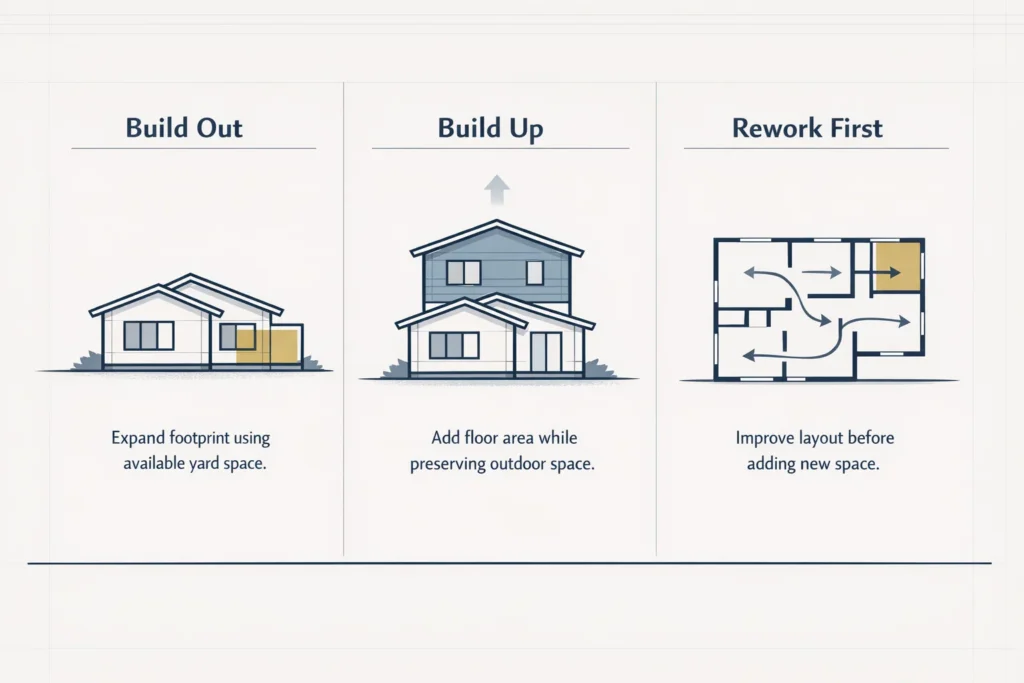
Should you build out, build up, or rework the existing layout?
There are usually three realistic ways to approach an extension, and the right choice depends entirely on your property.
1. Build out
This is often the best option when you have enough yard space and want a larger kitchen, stronger indoor-outdoor flow, or an extra bedroom at ground level. The upside is that ground-floor extensions can feel more natural and easier to integrate with day-to-day living. The downside is that they rely heavily on site space, drainage, and yard functionality.
2. Build up
Building up makes sense when the site is tight, you want to preserve outdoor space, or the extension needs to create significant extra floor area without eating up the yard.
However, second-storey extensions are not just “more rooms upstairs.” They often require structural steel, strengthening to the existing home, complex sequencing, higher scaffolding, and heavy weatherproofing. In plain English, building up usually costs more and carries more structural complexity.
3. Reconfigure first, then add only what is missing
Sometimes the best answer is not a massive extension. It is a smarter floor plan plus a smaller extension. That might mean reworking a cramped kitchen, relocating wet areas, or removing walls to improve flow, and then adding one targeted new space instead of chasing a much bigger footprint. A good builder will tell you if you are trying to solve a planning problem with unnecessary square metres.
How much does a home extension cost in Auckland?
Most builders dodge this question. They say things like “it depends” or “we would need to see plans first.” That is technically true, but it is not useful.
Here is the more honest answer. In Auckland, the budget for a home addition It is rarely driven by the area alone. The real cost blowouts usually come from the hidden conditions around the extension, not just the size of the room you want to add.
1. Earthworks and retaining on sloping sites
If your site is not flat, your extension may need excavation, retaining walls, more complex foundations, and advanced drainage solutions. That can turn a simple-looking extension into a much more expensive project.
2. Upgrading older homes to the current code
If your home is older, opening up the walls may reveal outdated plumbing, aging electrical systems, and structural framing that needs to be upgraded. Upgrading older homes to current code is not a “nice to have” luxury. It often becomes part of what is required to do the project properly and legally.
3. Structural steel and engineering
If you want wide open-plan spaces, major wall removals, large span openings, or a second-storey extension, structural steel and engineering costs can rise quickly. And once steel goes in, associated labour and complexity usually rise with it.
4. Difficult site access
If trades cannot get materials easily to the build area, labour costs go up. Needing crane lifts, manual handling, or special traffic management carries a very real price tag.
5. Kitchen, bathroom, and drainage changes
Adding a simple bedroom is one pricing category. A home extension that includes a new bathroom, a major kitchen relocation, drainage rerouting, and plumbing fixture changes is a completely different pricing category entirely.
6. Whether you stay in the home during construction
Some families want to remain in the home to save rental costs. Sometimes that works. Other times, it creates slower sequencing, requires more temporary protection work, and leads to longer build durations and labour inefficiency. It is not automatically the wrong choice, but it heavily impacts logistics.
A hard truth about pricing
Cost-per-square-metre shortcuts are often misleading for extensions. Extensions involve tying new work into old work. That means demolition, investigation, matching floor levels, dealing with hidden conditions, and keeping the existing house functioning. That is exactly why Preliminary Planning and Feasibility matters—it surfaces the real budget drivers before you commit to a design path.

How long does it take to plan and build a home extension in Auckland?
Homeowners do not just care about cost. They care about disruption. If you are planning around school terms, a new baby, or living in the house during the project, the timeline matters just as much as the money.
Feasibility and preliminary planning
This is the stage where you work out what is possible on the site, what type of extension makes sense, what will trigger consent, and what the major budget risks are. This is not the glamorous stage, but it protects the rest of the project.
Design and council approvals
In Auckland, almost all meaningful home extensions require a Building Consent. If the project pushes outside the Unitary Plan rules—such as setbacks or site coverage—you may need Resource Consent as well. Council processing alone can take 4 to 8 weeks, assuming there are no Requests for Further Information (RFIs) to stall the clock. Approvals are a real part of the project timeline and need to be treated that way from day one.
Construction
Construction timing depends on the scale of the extension, structural complexity, access, weather exposure, and how much of the existing house has to be opened up. A simple ground-floor extension and a complex second-storeyextension are not remotely the same thing. If someone gives you an easy, overconfident timeline without properly assessing the site, be careful.
What consents do you usually need for a home extension in Auckland?
For most Auckland home extensions, Building Consent is the baseline requirement.
Because you are changing the structure, egress, insulation, or plumbing, Building Consent is rarely optional.
You may also need Resource Consent if your project triggers planning rules, such as setback breaches, height-to-boundary breaches, or site coverage exceedances. A homeowner might think, “It is only one extra room,” but if that room pushes the project outside permitted development controls, the approval path changes.
The safest move is to test the consent pathway early, not after spending money on plans that are difficult to approve.

Why the traditional architect-first route goes wrong so often
This is the part that many homeowners only learn after losing money. The traditional route often goes like this:
- Hire an architect.
- Spend thousands on concept and developed plans.
- Fall in love with the design.
- Send it to builders for pricing.
- Find out that the build cost is nowhere near the budget.
Homeowners can spend $15,000 or more on architectural work, only to discover the design is too expensive to build. At that point, they have to pay more than planned, pay the architect again to redesign the project, or shelve the project entirely. That is not a planning strategy. That is an expensive sequencing mistake.
Why the design-build route is often the smarter path
The design-build model solves that problem by pulling buildability and pricing into the conversation early. Instead of designing in a vacuum, the project is shaped with real-world construction input from the start.
That means budget issues get flagged earlier, expensive design decisions are challenged sooner, and the scope can be adjusted before full drawings lock things in. Buildability stays tied to the design conversation, giving the homeowner a realistic roadmap from day one. If your top priority is budget alignment and avoiding expensive redraws, involving the builder early is the smarter move.
What does a Preliminary Planning and Feasibility process actually do?
It gives you answers before you overcommit. A strong Preliminary Planning and Feasibility process should help you understand:
- Whether the site can realistically support the extension you want.
- What planning or consent issues are likely to arise.
- What type of extension makes the most financial sense.
- What hidden cost drivers are likely sitting in the job.
- Whether your budget and your scope are actually aligned.
That is the value. It is the stage where you stop guessing. For the right homeowner, that clarity is worth far more than relying on a blind free quote or instant estimate that ignores half the real project risk.

What mistakes should homeowners avoid before starting a home extension?
Starting with sketches instead of feasibility
A sketch is not a strategy. If the site, structure, and budget have not been tested, drawings can send you down the wrong path quickly.
Underestimating hidden costs
The obvious part of the extension is not always the expensive part. It is often the access, drainage, retaining, structural steel, or service upgrades that blow the budget.
Assuming the council is a minor detail
In Auckland, consent is part of the project, not an afterthought. Treating it casually is one of the easiest ways to lose time.
Designing for extra space instead of better living
More area does not always mean a better home. Sometimes the real problem is the layout, not the size.
Choosing the team too late
If pricing, sequencing, and buildability only enter the conversation after the design is developed, you are already taking on more risk than necessary.
When should you speak with a design-build team?
Earlier than most people do. You should have that conversation when you know the house is no longer working, and you are serious about exploring an extension. It is the best move when you want budget reality before deep design spend, or if you suspect your site might be complex. This is especially true if you are still deciding whether to extend, reconfigure, or move entirely. The right early advice can save months of wasted motion.

What is the smartest next step if you are considering an extension?
Do not spend thousands on architectural plans only to find out your extension is not feasible.
Intelli Design Homes offers a Preliminary Planning and Feasibility conversation for Auckland homeowners who want clarity before committing to full working drawings. That process is designed to:
- Review your site and existing home.
- Assess likely Auckland Council constraints.
- Test whether your desired extension is suitable for the property.
- Identify key budget risks and hidden costs.
- Give you a realistic roadmap before the project gets expensive.
If you are serious about a home extension, this is the right first step. It helps filter out the wrong path before you have paid for plans that do not make financial sense.
Frequently asked questions about planning a home extension in Auckland
Yes. In most cases, they do. If you are changing structure, services, thermal performance, or layout in a meaningful way, Building Consent is usually part of the process.
Usually, the proposed extension breaches planning controls such as setbacks, site coverage, or height-to-boundary rules.
Not always, but second-storey extensions usually involve more structural work, more complexity, and higher disruption costs.
Sometimes. But it depends on the scale of work, where the extension connects to the existing house, and how safely the project can be staged.
Because homeowners often spend serious money on plans before confirming whether the design aligns with the real build budget. That is exactly what early builder involvement is meant to avoid.
Conclusion
Planning home extension in Auckland is not really about drawings first. It is about getting honest answers in the right order.
If the site works, the budget is realistic, and the approval pathway is clear, an extension can transform how your home functions. If those things are ignored early, the project can get expensive fast.
That is why feasibility matters, and that is why the first conversation should be about practicality, not just possibility.
If you are ready to find out what is actually possible on your property and what it will realistically cost, schedule a preliminary planning call with our team today to get the answers you need before you spend a single dollar on design.