Planning a Home Addition or Extension in Auckland? Here’s What You Need to Know

New Build in Auckland
If your home no longer suits the way you live, you are not alone. Many Auckland homeowners reach a point where they need more space, a better layout, improved flow, or more flexibility for a growing family. But while moving might seem like the obvious answer, it is often not the most appealing one. Relocating can mean leaving a neighbourhood you love, changing schools, adjusting your commute, and dealing with the disruption of finding and settling into a new property.


That is why home additions and extensions are such an important option to consider. A well-planned addition can help you stay where you are while creating a home that better supports how you live now and how you expect to live in the years ahead. It can mean a larger kitchen and living area, an extra bedroom, a more private main suite, a dedicated work-from-home space, or better separation between busy family zones and quieter areas.


The keyword, though, is well-planned. In Auckland, a successful home addition is not just about coming up with an appealing idea. It depends on how the proposed work fits the site, the existing structure, access, likely consent requirements, and the overall functionality of the home once the work is complete. The strongest projects are the ones that begin with clarity, not guesswork.


This guide is designed to help homeowners understand what goes into planning a home addition or extension in Auckland. We will cover the main project types, what affects suitability, cost factors, council and planning considerations, design principles, common mistakes, and the practical process from idea through to construction. We will also show why a feasibility study or preliminary planning conversation is often the smartest first move before committing to full design.

WANT AN INSTANT ONLINE ESTIMATE?

What are home additions and extensions?
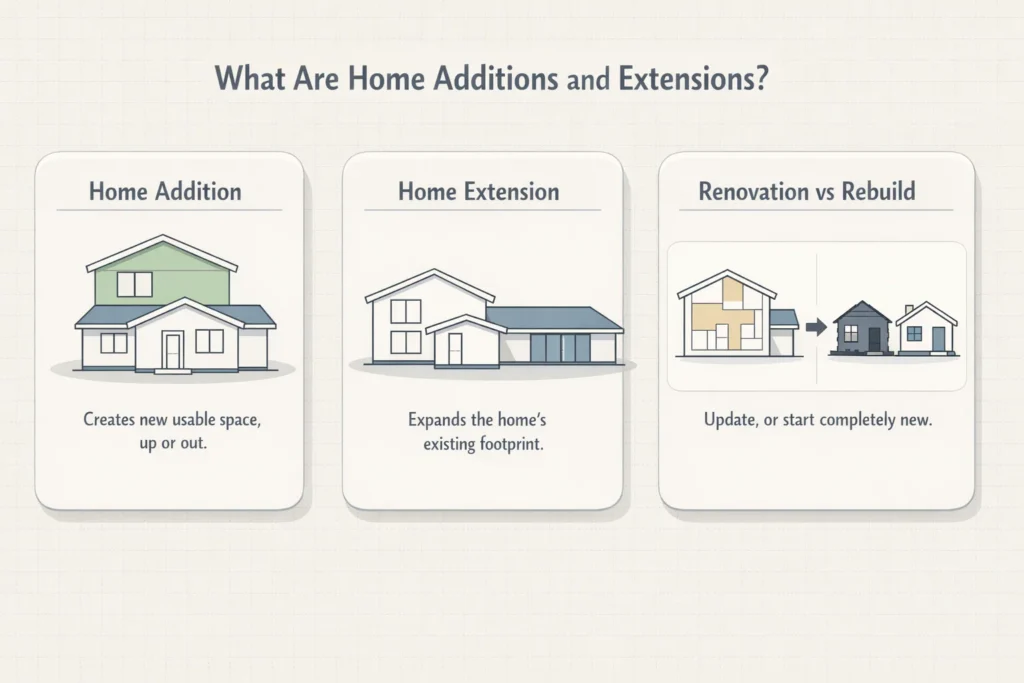
The terms home addition and home extension are often used as if they mean exactly the same thing. In everyday conversation, they usually overlap. But when you are planning a project, it helps to think a little more clearly about what each one can involve.


A home addition usually means adding new usable space to the property. That may involve extending part of the existing house, building upward with a second storey, converting an underused area, or, in some cases, creating a detached space that supports the main dwelling. The emphasis is on gaining additional functional space.


A home extension is often used more specifically to describe work that expands the footprint of the existing house. This could be a rear extension to enlarge a living area, a side extension to create more width and functionality, or a kitchen extension that changes how the main family spaces connect.


Both differ from a straightforward home renovation, in which existing rooms are refreshed, reconfigured, or upgraded without necessarily increasing the house’s overall size. They are also different from a full rebuild, where the existing home is replaced entirely.


For many Auckland homeowners, additions and extensions sit in the sweet spot between those two extremes. They offer the chance to improve the home you already own without starting over on a new site or taking on the scale of a complete rebuild. In practical terms, they can be one of the most effective ways to adapt a property to changing family life while preserving the location, character, and familiarity that made the home appealing in the first place.

Why homeowners in Auckland choose to extend

There is no single reason people choose to extend their home, but most projects begin with a feeling that the property is no longer working quite as well as it should.


For some households, the issue is simply a lack of space. A family may have grown, children may need separate bedrooms, or a once-flexible spare room may now be needed for another purpose. For others, the problem is not the amount of space but how it is arranged. Older homes, in particular, can have disconnected living zones, small kitchens, limited storage, or awkward circulation that no longer match how modern families live.


Working from home has also changed what many people need from their property. A dining table or corner desk may work as a short-term fix, but it rarely feels sustainable over the long term. A dedicated office, study nook, or quiet separate room can make a significant difference to how livable a home feels.


Some homeowners are also planning for multi-generational living. That can mean creating a more private area for an older parent, making room for adult children, or exploring a detached living arrangement such as a granny flat if the site and project scope support it.


Then there is the lifestyle factor. Many people genuinely like where they live. They may be settled in a neighbourhood, close to schools, connected to their community, and attached to the character of the house itself. In those situations, extending often feels more sensible than moving. It allows them to retain the location and familiarity they value while reshaping the property to meet current and future needs.


That is why a thoughtfully planned addition can be about much more than extra floor area. Done properly, it can improve comfort, functionality, flexibility, and the day-to-day experience of living in the home.

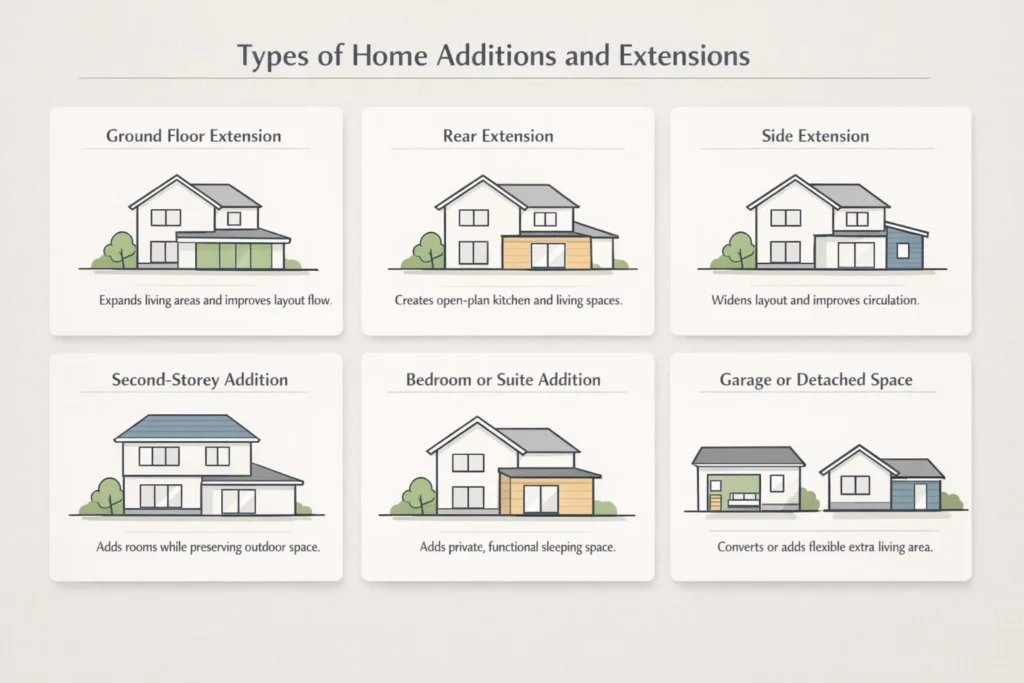
Types of home additions and extensions

One of the biggest mistakes homeowners make is assuming there is only one obvious way to add space. In reality, there are several different types of additions and extensions, and the right choice depends on your site, your home, your lifestyle, and what you are trying to solve.
 
Ground floor extensions
A ground-floor extension is one of the most common and versatile approaches. It can be used to enlarge a kitchen, create a more spacious dining area, add a living room, or make space for a bedroom, bathroom, or utility zone. It is often a strong option when there is enough room on the section and the goal is to improve how the core living spaces function.


Ground floor extensions can be particularly effective in homes where the existing layout feels too compartmentalised. By extending and reworking the plan at the same time, homeowners can often create a more open, practical, and family-friendly arrangement.


Rear extensions
Rear extensions are popular because they often transform the part of the house where people spend the most time. Extending out towards the back of the property can create a larger kitchen-living-dining hub, improve access to the garden, and strengthen indoor-outdoor flow.


For many households, this kind of project is not just about gaining space. It is about making the home feel lighter, more social, and easier to live in every day.


Side extensions
If there is underused space beside the house, a side extension may be worth exploring. This can be useful for widening narrow floor plans, adding practical utility space, improving circulation, or creating an extra room without pushing too far into the backyard.


Whether a side extension is workable depends heavily on the site and boundary conditions, which is one reason it should be assessed early rather than assumed.


Second-storey additions
Where land is limited or preserving outdoor space matters, building upward can be a strong alternative to building out. A second-storey addition can create several new rooms while keeping more of the section intact. This may suit growing families who need multiple bedrooms, an additional bathroom, or a private suite separated from the main downstairs areas.


That said, second-storey projects often involve more structural consideration than single-level extensions. They need careful planning around the existing home, access, staging, and how the new upper level integrates with the rest of the property.


Bedroom and suite additions
Some projects are driven by a very specific need: one more bedroom, a better guest room, or a more private main suite. Even when the addition itself sounds simple, the design still needs to work well with the rest of the house. The best bedroom additions do not feel like bolt-ons. They improve privacy, comfort, and flow at the same time.


Kitchen and living area extensions
This is one of the most impactful project types because it changes how the household experiences the home on a daily basis. A larger kitchen, better family room connection, more natural light, and improved storage can completely reshape the feel of the property. These projects also create natural opportunities for internal linking to related renovation content, such as kitchen renovations and bathroom renovations, where relevant.


Garage conversions
An underused garage can sometimes become valuable living space. Depending on the design and compliance requirements, a garage conversion may suit a home office, guest room, media room, or extra bedroom. It can be a useful option for homeowners who want to gain practical space without the same level of outward expansion.


Detached additional spaces
Some homeowners are looking for more independence or flexibility than an internal extension can provide. A detached additional space may be useful for family overflow, a hobby room, a studio, or a work area, depending on the site and design. Auckland Council’s guidance for detached structures also shows why early due diligence matters, especially where dimensions, site coverage, and boundary-related considerations come into play.


The right project type depends on more than aesthetics. It depends on what the home lacks now, how you want it to function in future, and what the property can realistically support.

Is your property suitable for an addition?

Not every house is equally suited to every kind of addition. Before you become too attached to a layout idea or visual concept, it is worth stepping back and asking whether the property itself supports the kind of project you have in mind.


The first thing to look at is the site layout. The position of the existing house on the section, the amount of usable land around it, and how much outdoor space you want to retain can all influence what sort of extension makes sense. A concept that seems straightforward in theory may become far less practical once site realities are taken into account.


The second factor is the existing structure. Some homes are relatively straightforward to build onto. Others may have older structural systems, awkward roof forms, previous alterations, or limitations that make certain kinds of work more involved. None of that automatically rules a project out, but it does affect how the project should be approached.


Access is another important consideration. Building materials, trades, and equipment need to be able to move through or around the site. Tight access does not necessarily prevent an addition, but it can influence staging, complexity, and project planning.


It is also important to think about services and site constraints early. Drainage, stormwater, site coverage, slope, and how the land is currently used can all shape design possibilities. Auckland Council’s project guidance highlights exactly why it helps to know the proposed dimensions, where work will sit on the site, and how much of the property is already covered by buildings or hard surfaces before moving too far ahead.


Then there are boundary and planning considerations. If a proposed structure sits close to a boundary or creates specific planning issues, that may affect how the design develops or what approvals may be needed.


This is why a feasibility study is often the most valuable first step. It helps you assess whether the property can support the addition you want, whether another type of solution might be better, and how to avoid spending money too early on the wrong concept.

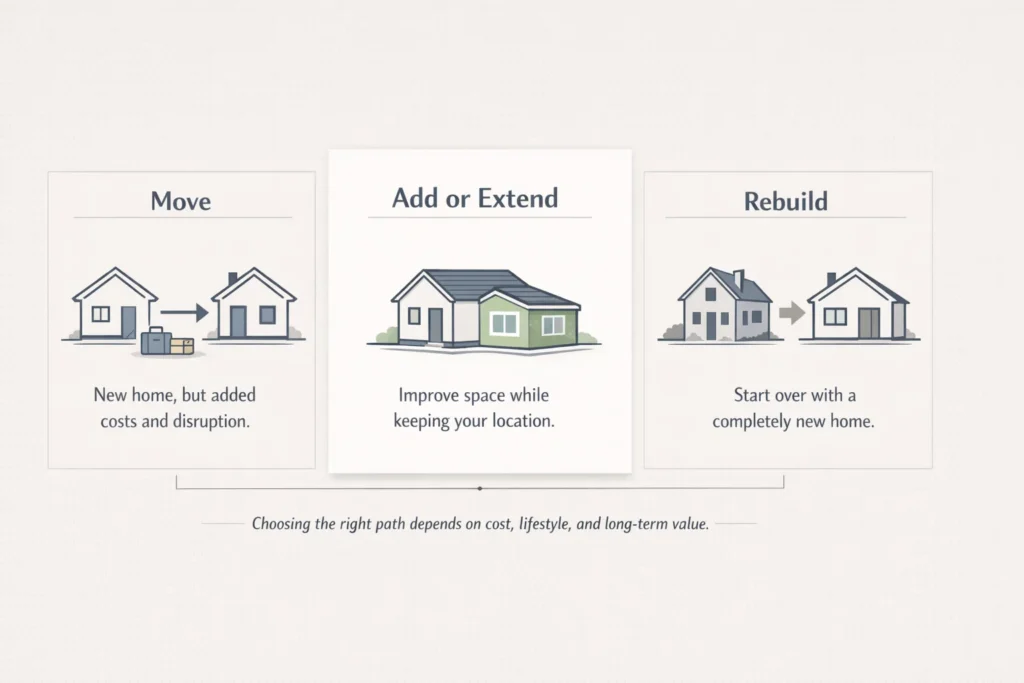
Additions vs moving vs rebuilding

When a home no longer fits your needs, it is tempting to jump straight to a single solution. But in reality, most homeowners are weighing up three broad options: extend, move, or rebuild.


Moving can be attractive because it seems like a clean reset. But it also comes with trade-offs. You may leave a location you value, spend heavily on the move itself, and still end up in a house that needs work to be truly suitable.


Rebuilding may make sense when the existing home has significant limitations, the desired changes are extremely extensive, or the property would benefit more from a full redesign than an adaptation. But rebuilding is a much larger commitment and is not always necessary to achieve a better living outcome.


An addition or extension often sits in the middle. It tends to make the most sense when you like your section, value your location, and believe the existing home still has strong potential. A good extension can unlock that potential by improving layout, flow, and functionality without discarding the entire home.


The decision should not be based only on emotion or convenience. It should be based on the route most likely to deliver the best long-term results for your property, lifestyle, and priorities. That is another reason why early planning is so useful. It allows you to compare options more realistically before committing to a path.

What affects the cost of a home addition?

Many homeowners begin their research by searching for a cost figure, but additions and extensions rarely work that neatly. Costs are shaped by a combination of design decisions, site conditions, and construction realities, which is why it is more useful to understand the main cost drivers than to rely on generic online numbers.


One of the biggest factors is scope. A simple room addition is very different from a larger project that changes structural elements, reorganises the floorplan, and incorporates kitchens, bathrooms, or substantial services work.


Structural complexity also matters. If the addition requires significant changes to load-bearing parts of the house, rooflines, upper-storey support, or complicated junctions between old and new work, the level of coordination involved increases.


Projects involving wet areas or service changes often require more planning because they affect plumbing, drainage, waterproofing, and internal systems, not just visible finishes.


Site access and site conditions can also play a major role. Tight access, sloping ground, constrained working areas, and unusual property conditions can all make the build more demanding.


Then there is the issue of materials and finish selections. The more carefully the addition is designed to integrate with the home, the more attention may be needed around detailing, continuity, and the final quality of the finished space.


Finally, planning quality significantly affects cost certainty. A poorly scoped project is far more likely to encounter redesigns, shifting assumptions, or scope creep. That is why many homeowners benefit from starting with an instant online estimate and then moving into a more detailed planning process to assess the project’s true scope.

Council consents and Auckland regulations
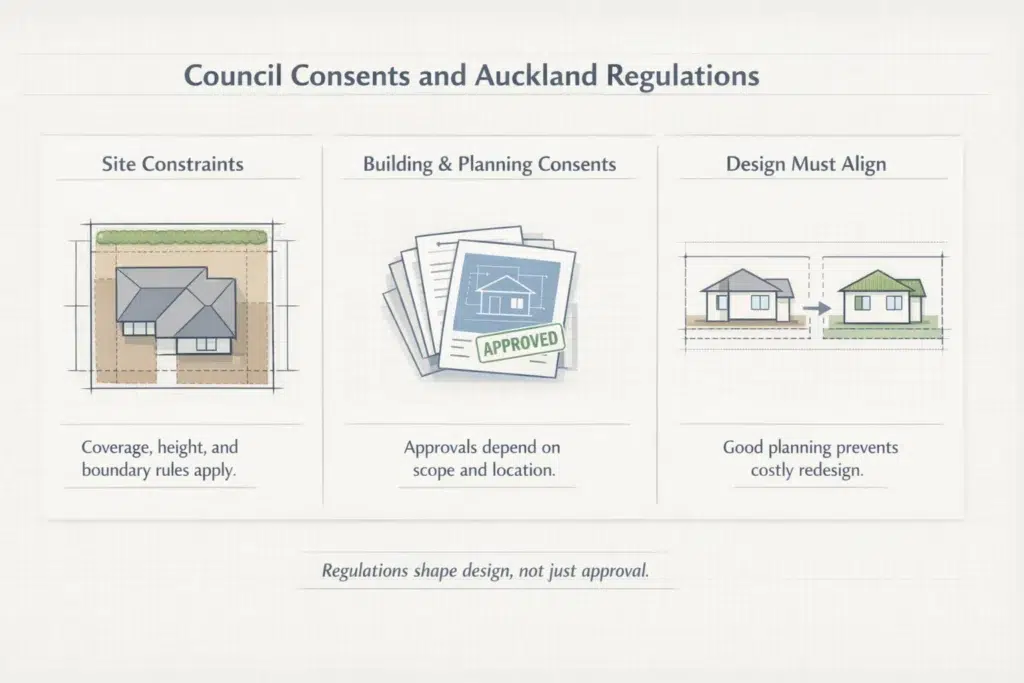
One of the clearest reasons to plan carefully is that home additions sit within a wider building and planning framework. Depending on the size, nature, and location of the project, there may be building consent requirements and, in some cases, broader planning matters to consider.


The exact requirements will depend on the site and the proposal, which is why it is important not to assume that a project is simple just because it seems physically modest. In Auckland, site coverage, dimensions, proximity to boundaries, drainage impacts, and the nature of the existing property can all influence the path forward.


Auckland Council’s project guidance for detached structures is a useful reminder of the sorts of details that matter early on. For example, it highlights the importance of understanding the proposed dimensions, where the work will sit on the site, and how much of the section is already covered by buildings or hard surfaces. It also notes that when work is near a boundary, neighbour-related considerations may be relevant in certain situations.


More broadly, homeowners should remember that consent-related questions are not just paperwork questions. They can shape the design itself. A strong planning approach aligns the concept with site realities before too much time and money have gone down the wrong path.


This is part of what supports stronger EEAT-style content in practice: not making sweeping claims, but demonstrating a clear, practical understanding of how projects are actually evaluated and delivered.


Helpful external references for this topic include Auckland Council’s guidance on building and renovation projects and its page on build or extend a sleepout or cabin, both of which reinforce why site-specific due diligence matters.

Design principles for a successful home addition

A successful addition is not simply one that adds space. It is one that improves the experience of living in the home.


One of the most important principles is integration. The new work should feel like it belongs with the original home rather than appearing as an afterthought. That applies to internal flow, roof form, proportions, finishes, transitions, and how the old and new areas relate to one another.


Another important principle is liveability. The addition should support how the household actually functions. That may mean creating better separation between private and shared zones, improving visibility for family life, designing more useful storage, or making circulation more intuitive.


Natural light and ventilation also matter. It is surprisingly easy to create a larger home that feels heavier, darker, or more awkward. A good design should improve the quality of the space, not just its quantity.


It is also worth thinking beyond immediate needs. A room that works well as a nursery today may later become a study, guest room, or teenager’s bedroom. Designing with future flexibility in mind can make the addition more durable and more valuable over time.


Lastly, a successful addition should improve the property’s overall balance. It should help the home feel more coherent, more functional, and more enjoyable to live in day after day. That is what separates a well-designed addition from one that simply adds square metres.

Common challenges with Auckland home additions
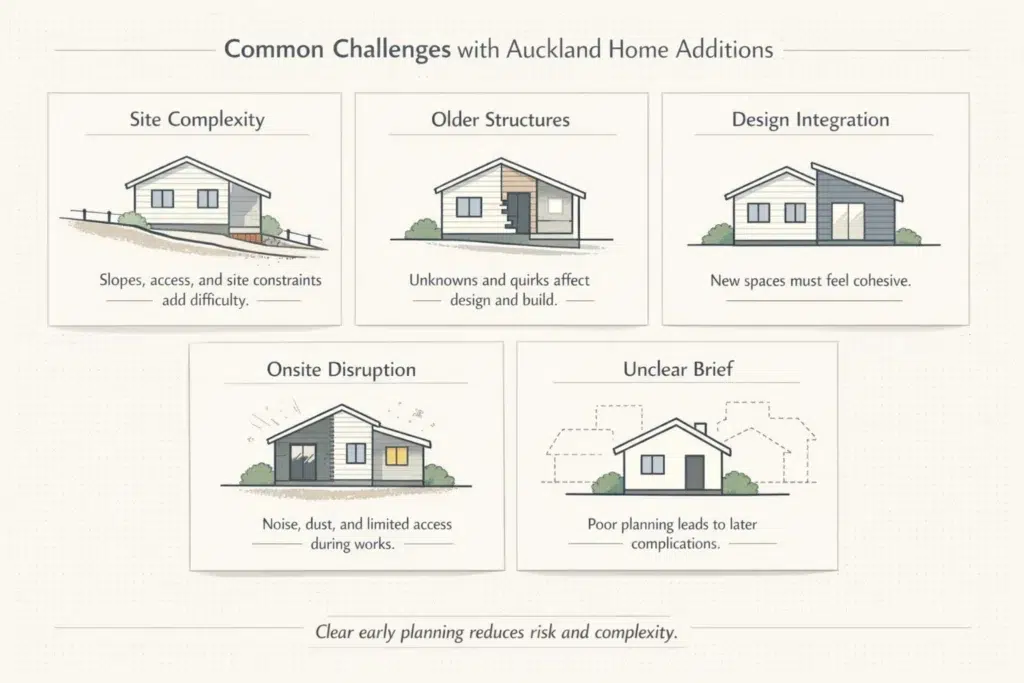
Even excellent projects come with challenges, and understanding those challenges early can make the whole process more manageable.


A common issue is site complexity. Auckland homes sit on a wide range of sections, and not every property makes access, staging, or structural integration straightforward. Slopes, narrow accessways, retained areas, and previously altered homes can all add complexity.


Another challenge is working with older homes. Older properties often have character, but they can also come with structural quirks, dated layouts, and unknowns that only become clearer as planning progresses.


There is also the challenge of matching old and new. A good extension should feel coherent. A poor one can undermine the look and function of the original home.


For households remaining onsite during the work, day-to-day disruption is another important issue. Noise, temporary loss of access to parts of the house, dust, and the practical demands of a live construction environment all need to be considered.


Finally, one of the biggest challenges is simply uncertainty at the start. When the brief is vague or the feasibility has not been properly tested, issues tend to surface later when they are harder to solve. Clearer early thinking almost always leads to smoother project development.

Common mistakes homeowners should avoid

Plenty of problems in addition to projects begin before anyone starts building.
One of the biggest mistakes is starting with only a vague idea of what “more space” means. If you do not define what problem the project needs to solve, it becomes much harder to judge whether the eventual design is actually successful.
Another is going too quickly into planning or pricing without first testing the site and scope. If practical constraints, likely approval issues, and realistic project options have not been explored, there is a much higher chance of redesign and frustration later.
Homeowners sometimes also focus too much on size rather than on function. Bigger rooms do not automatically create better homes. The quality of the layout matters just as much as the amount of floor area gained.
A further mistake is underestimating the importance of integration. The new work needs to connect naturally with the original house in a way that improves, rather than compromises, the overall property.
And finally, many people treat the planning phase as optional when it is actually one of the most important stages. A proper feasibility or preliminary planning process is not wasted time. It is often what prevents expensive missteps later.

What the process looks like from idea to build
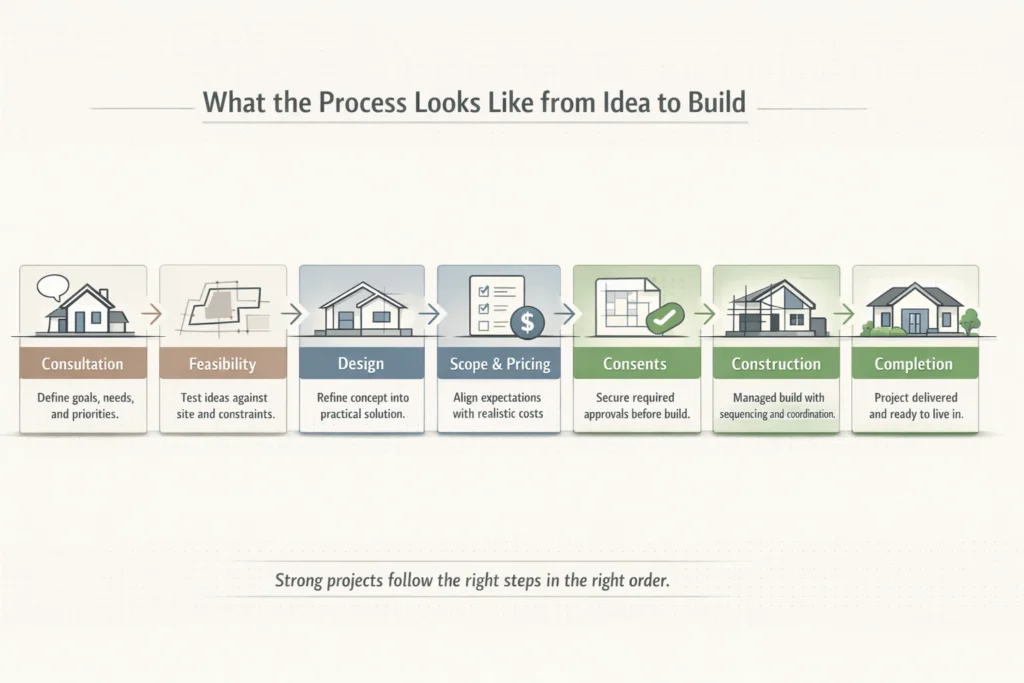
Although every project is different, most successful home additions move through a broadly similar sequence.


The first stage is usually an initial consultation. This is where the homeowner’s goals, frustrations, preferences, and practical needs are discussed. The purpose is to go beyond “we need more room” and get specific about what kind of room, what functionality it needs, and why it matters.


The next smart step is usually feasibility or preliminary planning. This is where the idea begins to be tested against the realities of the site, the house, and the likely project direction. It helps identify what is possible, what may be constrained, and where the strongest opportunities sit.


From there, the project can move into design development, where the preferred concept is refined into a more detailed and practical proposal.


After that comes scope clarification and pricing alignment. This stage gives the homeowner a more grounded view of what the project entails and helps shape expectations before construction planning proceeds.


Depending on the nature of the work, the project may then proceed to consent- and approval-related stages.


Only after the project is properly prepared does it move into construction. At that point, sequencing, communication, and project management become central to achieving a smoother experience.


Finally, there is completion and handover, where the space becomes part of everyday life, and the value of the planning work starts to show.


The most important takeaway is simple: successful additions are rarely the result of rushing. They are the result of making the right decisions in the right order.

Frequently Asked Questions

Depending on the size, scope, and location of the project, building consent and other planning considerations may apply. Because each site is different, it is best to assess likely requirements early rather than assume the project will be straightforward.

A renovation improves or reworks existing spaces. An extension generally expands the footprint of the house. A home addition is a broader term that can include extensions, extra rooms, second-storey projects, garage conversions, and other new spaces added to the property.

In some cases, yes. Whether it is practical depends on the current structure, the site, and the scope of the design. It can be a useful solution where land is limited, but more accommodation is needed.

That depends on the scale and staging of the project. Some homeowners remain in the home during parts of the work, while others find it more practical to stay elsewhere during the most disruptive stages.

A well-designed addition can improve liveability, appeal, and overall functionality, potentially strengthening the property’s value. The outcome depends on the quality of the design, the execution, and how well the new work suits the home.

The best first step is to conduct a feasibility study or hold a preliminary planning discussion. That helps you understand what may be possible on your site, what constraints could shape the project, and which direction is worth pursuing before moving into detailed design.

Conclusion

A home addition or extension can be one of the smartest ways to improve your property’s functionality without giving up the location and familiarity you already value. It can create more space, better flow, improved comfort, and a layout that supports the way you actually live.


But the best outcomes do not come from rushing into plans. They come from understanding the site, the house, the likely constraints, and the most suitable path forward before too much has been committed. That is why a strong addition begins with clarity.


If you are thinking about extending your home, the most practical next move is to start with a planning-led conversation. Intelli Design Homes can help you explore the options through a consultation, a preliminary planning discussion, or an instant online estimate. Starting that way gives you a clearer foundation for every decision that follows.

Reset password

Enter your email address and we will send you a link to change your password.

Powered by Estatik